Why Your Office Aircon is Inefficient (And How It Affects Productivity)
In Singapore’s tropical climate, an efficient commercial air conditioning system is not a luxury—it is a vital business asset. For business owners, facilities managers, and HR directors, maintaining a balanced indoor climate directly impacts employee health, daily focus, and operational overheads. When an office aircon operates at peak performance, employees remain sharp, comfortable, and productive.
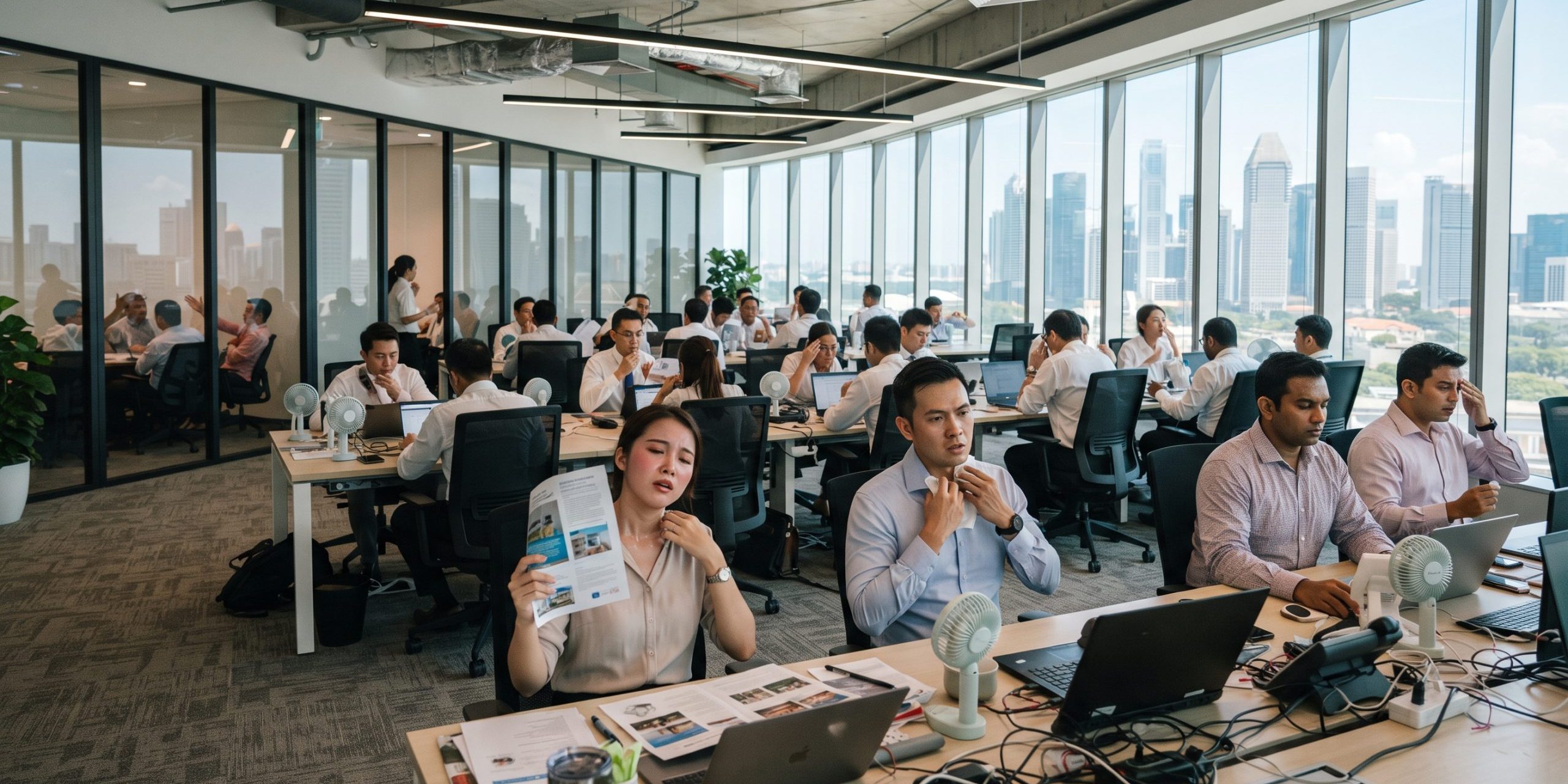
However, when an office HVAC or split-system becomes inefficient, it triggers a chain reaction of financial and operational problems. Skyrocketing electricity bills from SP Group eat directly into your profit margins, while fluctuating room temperatures and poor air quality lead to staff discomfort, fatigue, and increased medical leave. Understanding the underlying causes of commercial aircon inefficiency allows you to take proactive steps before a minor fault escalates into a costly system failure.
Primary Reasons Your Office Aircon Is Underperforming
Commercial air conditioning systems endure heavy operational stress, running anywhere from 8 to 12 hours a day, five to six days a week. Unlike residential units, this continuous duty cycle rapidly accelerates component wear, filter clogging, and electrical strain.
- Compounded Servicing Neglect: Without scheduled maintenance, commercial systems lose roughly 5% of their total energy efficiency every year. Accumulated dust on heat exchanger coils acts as an insulator, forcing the compressor to draw significantly more power to achieve the same cooling output.
- Bacterial Slime & Mould Accumulation: Singapore’s persistent 80%+ relative humidity creates an ideal environment for algae, mould spores, and bio-slime to thrive inside damp fan coil drip trays. Circulating these pathogens through office ductwork leads to “Sick Building Syndrome,” triggering allergies, asthma, and employee absenteeism.
- Thermostat Mismanagement: Setting office thermostats to 18°C in an attempt to cool a room faster is a common mistake. Cooling speed is determined by airflow and compressor capacity, not setpoint temperature. Setting controls too low simply locks the compressor into high-power continuous operation, drastically inflating utility bills without improving speed.
- Unregulated After-Hours Cooling: Failing to adjust temperature settings during overnight hours or weekends wastes thousands of kilowatt-hours annually cooling empty desks and conference rooms.
- Leaky Concealed Ductwork: In offices with false ceiling installations, cracked, loose, or uninsulated supply ducts leak cool air into unconditioned ceiling voids. Conversely, leaking return ducts pull hot, humid air into the cooling stream, overloading the system.
- Restricted Outdoor Condenser Airflow: Outdoor condenser units located in tight service yards, carparks, or rooftop enclosures frequently collect airborne litter, leaves, and grease. Restricted airflow prevents heat rejection, causing thermal cut-offs and compressor burnout.
The True Cost: Energy Waste vs. Reduced Workplace Productivity
An inefficient aircon impacts more than just the monthly utility statement. Thermal discomfort directly alters cognitive performance and workplace morale:
- Elevated Operating Expenses: Air conditioning accounts for up to 40–50% of a commercial building’s total energy consumption in Singapore. An unserviced, dirty system can increase electricity costs by 15% to 30% per month.
- Decreased Employee Focus: Studies show that workplace temperatures above 25°C or below 21°C lead to higher error rates, slower typing speeds, and reduced decision-making accuracy.
- Preventable Equipment Capital Expenditure: Running a system with dirty coils or low refrigerant forces internal components to operate under extreme head pressure, cutting a commercial system’s operational lifespan from 10–12 years down to 5–7 years.
Commercial Troubleshooting Matrix: In-House Checks vs. Professional HVAC Maintenance
Managing a commercial facility requires a clear line between basic operational adjustments and technical technical intervention:
| Issue / Symptom | Safe Facilities (In-House) Action | Professional Technical Solution |
|---|---|---|
| Soaring Electricity Bills | Set primary office thermostats to 23°C–25°C and program automated timer shutdowns. | Conduct total energy audits, verify motor run ampers, and optimize refrigerant pressures. |
| Unpleasant / Musty Odours | Ensure return air grilles are clear of paper, boxes, or high office furniture. | Perform deep chemical flushing/overhaul on indoor fan coils, blowers, and condensate pans. |
| Uneven Temperature / Hot Spots | Check that supply air diffusers are open and not blocked by office partitions. | Inspect concealed ceiling ductwork, seal air leaks, and balance motorized airflow dampers. |
| System Overheating / Short-Cycling | Keep outdoor condenser areas clear of debris, trash bags, and physical obstructions. | Chemical-wash outdoor condenser coils, test electrical relays, and replace worn capacitors. |
| Water Dripping from Ceiling Units | Clear surrounding office equipment and turn off power to the affected fan coil unit. | Clear blocked condensate drain lines using high-pressure wet vacuuming and flush bio-slime. |
Comprehensive Preventative Maintenance Schedule for Commercial Spaces
To keep an office cooling system running efficiently year-round, facilities managers should adopt a structured maintenance routine:
- Bi-Weekly: Inspect and wash return air mesh filters in high-traffic office areas.
- Monthly: Check programmable thermostats, clear outdoor condenser perimeters, and monitor indoor humidity levels.
- Quarterly (Professional Service): Engage licensed technicians to clean fan coils, check electrical connections, test condensate drainage, and inspect overall refrigeration circuit health.
- Annually (Deep Overhaul): Perform comprehensive chemical coil washings, ductwork leakage inspections, and full VRV/VRF system diagnostic testing.
Need Professional Office Aircon Servicing in Singapore?
If your office air conditioning system is blowing warm air, making unusual noises, leaking water, or causing excessive electricity bills, our experienced commercial technicians provide fast, reliable, and thorough maintenance services tailored to your business operations.
Contact Our Experts Today:
- Company Name: Aircon Servicing & Repair Singapore
- Address: 269 Bukit Batok East Ave 4, Singapore 650269
- Phone: +65 9855 3721
- WhatsApp: Chat on WhatsApp