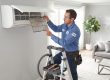
That persistent dry cough your child has had for three weeks isn’t always a cold. That scratchy throat your family members complain about every morning isn’t just dry weather. And that fine, grey film settling on your furniture just hours after wiping it down isn’t ordinary household dust.If you live in Marymount, Ang Mo Kio, Novena, Serangoon North, Hougang, Tengah, or Brickland, this is a direct result of construction dust—and an unserviced aircon is actively circulating it through your home.Singapore is undergoing massive infrastructure expansions. The North-South Corridor (NSC) tunnel works, Cross Island Line (CRL) excavations, Brickland MRT construction, and ongoing Tengah BTO developments generate vast amounts of heavy, chemical-laden particulate matter.Standard aircon servicing cannot handle this environment. In construction hotzones, your air conditioning system requires specialized chemical washing to protect both your equipment and your family’s respiratory health.The 2026 Construction Hotzone MapIf your home falls into any of these major project corridors, your aircon unit is operating in a high-impact dust zone:North-South Corridor (NSC) Sector (Marymount, Thomson, Ang Mo Kio, Novena, Toa Payoh): Heavy subterranean excavation removes marine clay and granite-heavy earth. Road realignment generates bitumen-coated silica dust that clings aggressively to aluminum aircon fins.Cross Island Line (CRL) Phase 1 (Serangoon North, Tavistock, Hougang, Defu): Deep station box excavation and industrial mixing create acidic, sticky particulate that rapidly bypasses basic filter mesh.Western Sector (Keat Hong, Brickland, Tengah): Rail cutting and ongoing building construction generate fine concrete and metallic dust. These sharp particles accelerate mechanical wear and risk shorting electrical components.Why Construction Dust Destroys Standard Aircons: “Micro-Concreting”Construction dust differs fundamentally from biological household dust (skin cells and fabric fibers). It consists of crystalline silica and calcium silicates (cement compounds) sized well under PM2.5.[ Airborne Construction Dust (Silica / Cement) ]
│
▼
[ Sucked into AC Unit & Bypasses Basic Filters ]
│
▼
[ Settles on Cold, Wet Evaporator Coil ]
│
▼
[ Dust Hydrates with Condensate Moisture & Cures ]
│
▼
[ Hardened “Micro-Concrete” Layer Traps Bio-Slime & Mold ]
When fine cementitious dust lands on your aircon’s wet evaporator coil, Singapore’s high humidity triggers a chemical reaction. The dust hydrates, cures, and hardens directly onto the aluminum fins—a process known as micro-concreting.Once hardened, this crust cannot be washed away with water or light brushing. It locks in moisture, forming an ideal breeding ground for toxic mold spores (Aspergillus and Penicillium) that are blown back into your living space every time the unit runs.Comparison: Standard General Service vs. Chemical WashService FeatureStandard General ServiceChemical Wash (Hydro-Clean)Primary ActionWashes filter mesh, light surface wipe down, vacuums drain tray.Full system disassembly, deep chemical foaming, high-pressure coil rinse.Dust Type TargetLarge, biological household dust (>50 microns).Hardened silica, fine concrete dust (PM2.5), micro-cemented crust.Chemical ReactionNone (Uses plain water).Alkaline foaming agents dissolve silicate binders and break down bio-slime.Coil PenetrationSurface-level only; often packs dust deeper into the coil core.Expands between 1.5mm fin gaps to push compacted debris completely out.Recommended Frequency (Dust Zones)Every 3 Months (Basic upkeep).Every 6 Months (Essential for health & efficiency).The True Cost of Neglect in Construction HotzonesUsing standard servicing in heavy construction areas triggers a rapid degradation cycle:Surging Electricity Bills: Hardened dust acts as thermal insulation. Your system runs continuously at peak capacity to reach target temperatures, raising electricity costs by 15% to 30%.Premature Equipment Failure: Silica particles act as an abrasive paste inside blower fan bearings, while blocked coils force the compressor into thermal overload. Aircon lifespan drops from a standard 10–12 years down to 6–7 years.Respiratory Health Risks: Continuous circulation of PM2.5 particulates and fungal spores exacerbates childhood asthma, causes chronic dry coughs, and triggers sick building syndrome in elderly family members.Practical Protection Plan for High-Dust Areas1.Preventative Barrier Setup:Keep windows closed during peak work hours (8 AM – 7 PM). Install electrostatic filter sheets over standard AC mesh filters to help capture fine particles. Run a standalone HEPA air purifier in bedrooms to reduce overall particle load.2.Establish a Construction-Zone Maintenance Schedule:Wash basic mesh filters bi-weekly. Schedule a standard professional general service every 3 months, and book a full chemical wash every 6 months to strip away accumulated cementitious crust before it hardens permanently.3.Post-Construction Recovery Overhaul:Once major infrastructure work in your area completes, commission a complete chemical overhaul. Technicians fully dismantle the unit to sanitize the chassis, blower wheel internals, and drainage lines, restoring the equipment to optimal baseline performance.
011 322 44 56Monday – Friday 10 AM – 8 PM
Aircon Servicing
Aircon Servicing & Repair Singapore


- Home
- Servicing
- Chemical Wash
- Chemical Overhaul
- Gas Top-Up
- Repair
- Shop
- About
- Reviews
- Blog
- Installation
⭐ Google 5.0 · 200+ reviews
📍 Serving all of Singapore
⚡ Same-day appointments available
🇸🇬 Singapore's Trusted Aircon Specialists
⭐ Google 5.0 · 200+ reviews
📍 Serving all of Singapore
⚡ Same-day appointments available
🇸🇬 Singapore's Trusted Aircon Specialists