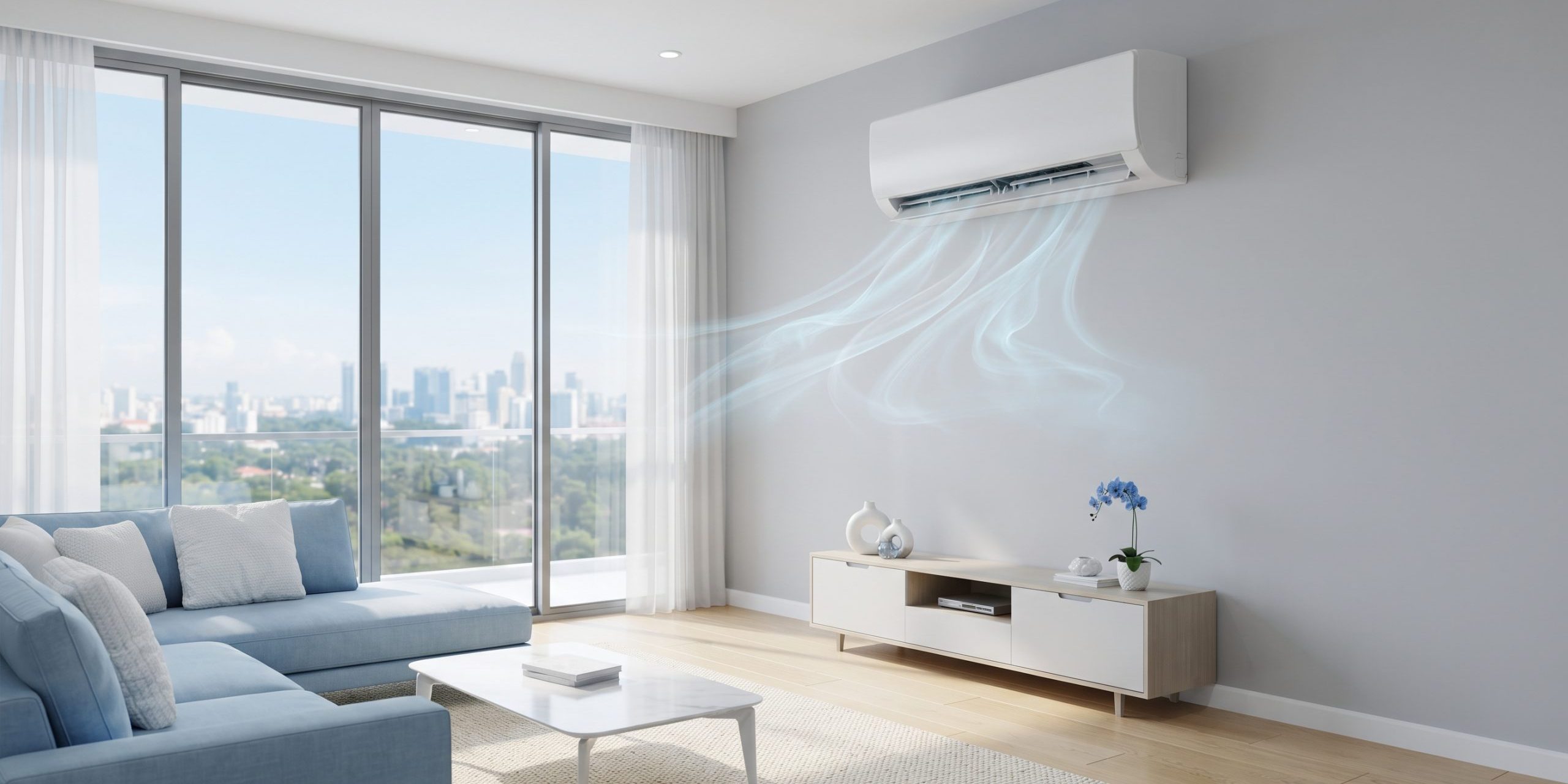
The reason two rooms set to the exact same thermostat temperature ($24^circtext{C}$) can feel vastly different comes down to microclimates and heat transfer mechanics. Your air conditioner controls overall air temperature at its thermostat sensor, but human perception of cold depends on humidity levels, air velocity across your skin, radiant heat, and room geometry.
Environmental Factors Influencing Perceived Coldness
| Factor | Mechanism / Impact on Comfort | Perceived Effect |
| Air Velocity (Wind Chill) | High airflow accelerates moisture evaporation from human skin. | Direct air currents make a $24^circtext{C}$ room feel like $21^circtext{C}text{–}22^circtext{C}$. |
| Relative Humidity | Lower indoor humidity allows faster natural body heat dissipation. | Dry rooms feel crisp and cold; humid rooms feel sticky and warmer. |
| Radiant Heat & Solar Gain | West-facing walls and windows radiate absorbed heat inward. | Walls radiate warmth even if the air itself reaches $24^circtext{C}$. |
| Room Size & Ceiling Height | Cold air naturally sinks; high ceilings trap warm air near the top. | Compact rooms with lower ceilings cool down much faster. |
| Aircon Coil Cleanliness | Clogged fan blower wheels distribute air unevenly across the space. | Inconsistent circulation creates cold spots and hot dead zones. |
Key Science Behind Thermal Comfort
- Sensible vs. Latent Heat: Air conditioners must remove both sensible heat (lowering the temperature reading) and latent heat (removing moisture). A room with lower humidity allows your body to cool itself far more effectively.
- The Wind Chill Effect: Moving air increases convective heat loss from your body. A unit blowing air directly toward a bed or sofa makes that room feel significantly colder than a room where air circulates overhead.
- Thermostat Sensor Location: Aircon thermostats measure the temperature of the air entering the indoor unit intake, not the air at human level. High ceilings or poor circulation cause the unit to shut down or step down power prematurely.
Step-by-Step Sequence to Balance Room Cooling
1.Adjust Vane Louvers and Airflow Direction:Redirect direct drafts.
Position indoor unit louver blades upward or horizontal so cold air distributes evenly across the ceiling instead of dumping directly onto one seating area.
2.Install Thermal Curtains on West-Facing Windows:Block solar heat gain.
Use blackout blinds or solar-tinted window films on rooms exposed to direct afternoon sun to reduce radiant heat transfer through glass.
3.Use Oscillating Fans in Corner Dead Zones:Enhance air distribution.
Place a small standing fan in rooms that feel warmer to break up thermal dead zones and help cool air circulate back toward the aircon sensor.
4.Clean Evaporator Coils and Blower Wheels:Restore system performance.
Perform routine coil cleaning and filter washing bi-weekly. Dust-choked blower wheels restrict air throw, creating uneven cooling across rooms.
Professional Aircon Care & Balancing
If certain rooms in your home remain uncomfortably warm or struggle to cool down despite proper settings, internal duct blockages, low refrigerant levels, or improper system sizing may be the underlying cause.
At Aircon Servicing & Repair Singapore, our certified engineering team provides full-system thermal diagnostics, chemical coil flushing, and multi-split balancing services across Singapore.
- Company Name: Aircon Servicing & Repair Singapore
- Address: 269 Bukit Batok East Ave 4, Singapore 650269
- Phone: +65 9855 3721
- WhatsApp Direct:Click Here to Message Us Directly on WhatsApp