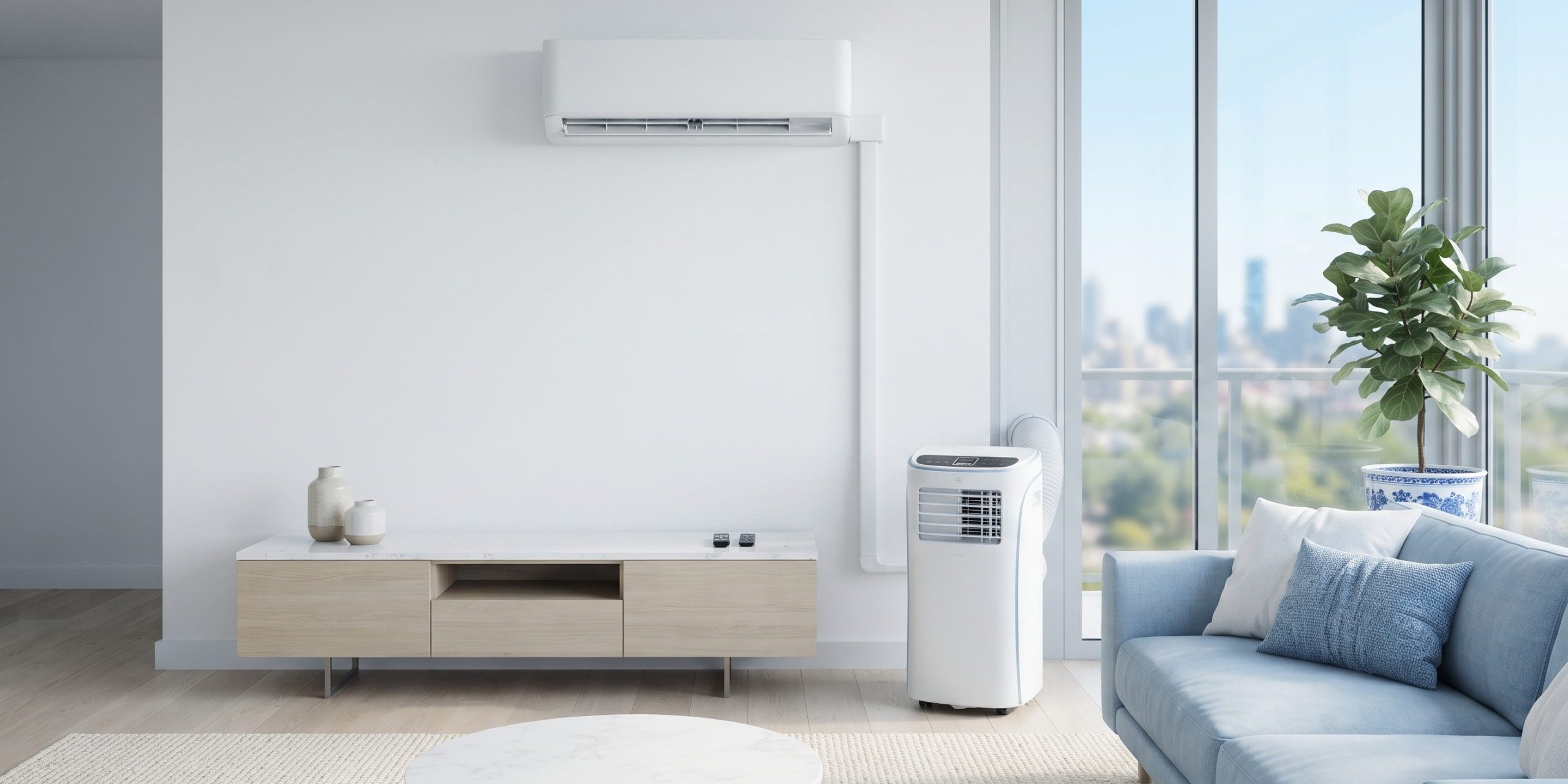
When deciding between a split unit aircon and a portable aircon, the best choice comes down to whether you prioritize long-term energy efficiency and powerful cooling or low upfront costs and portability.
For homeowners in Singapore, split units are the gold standard for daily use. However, portable aircons serve as a practical, temporary solution for renters, rooms without window access, or spaces where permanent compressor installation is prohibited.
Split System vs. Portable Aircon Comparison Matrix
| Feature / Metric | Split Unit Aircon | Portable Aircon |
| Cooling Power & Speed | High: Rapidly cools medium-to-large rooms ($9,000text{–}24,000text{ BTU}$). | Moderate: Best for small, enclosed spaces ($9,000text{–}12,000text{ BTU}$). |
| Energy Efficiency | High: Inverter technology delivers top energy ratings (up to 5-tick). | Lower: Runs non-inverter compressors continuously, driving up power bills. |
| Noise Level | Very Quiet: Compressor is located outside on the bracket/yard. | Noisier: Compressor and exhaust fan are inside the room ($50text{–}60text{ dB}$). |
| Installation Requirements | Requires certified professional installation, trunking, and outdoor bracket. | Plug-and-play into a standard power outlet; requires a window exhaust hose kit. |
| Upfront vs. Long-Term Cost | Higher upfront cost; cheaper long-term running costs. | Lower upfront cost; higher monthly electricity bills. |
Key Performance Differences
- Compressor Placement: Split units keep noisy, heat-generating compressor components outside the room. Portable units keep everything indoors, forcing the internal fan to run constantly to dump hot air through a flexible exhaust duct.
- Negative Pressure Issues: Single-hose portable aircons pull cooled air from the room to exhaust heat outside, creating negative pressure that draws warm air in through door gaps.
- Property Suitability: Split units are ideal for HDB/Condo homeowners seeking high efficiency. Portable units suit short-term tenants or temporary arrangements where wall drilling is restricted.
Decision Sequence: Choosing the Right Unit for Your Home
1.Evaluate Your Living Situation:Ownership vs. Tenancy.
If you own your flat or plan to stay long-term (>2 years), opt for a split system. If you are on a short-term lease or renting, choose a portable unit to avoid setup costs.
2.Calculate Required Cooling Capacity (BTU):Matching capacity to floor area.
Measure your room space. Standard bedrooms require $9,000text{–}12,000text{ BTU}$, while large living rooms require $18,000text{–}24,000text{ BTU}$. Portable units struggle in spaces larger than 150 sq ft.
3.Verify Exhaust Window Access for Portable Units:Window setup check.
Ensure your room has a sliding or louvred window nearby to attach the hot-air exhaust duct. Unvented portable units will not cool a room.
4.Check Energy Efficiency Ratings:Inverter savings.
When buying a split system, choose a 5-tick inverter model to minimize long-term electricity consumption and maximize government rebate eligibility.
Professional Aircon Servicing & Installation
Whether you require a multi-split system installation or regular maintenance for your existing aircons, professional installation and servicing ensure lower running costs and a longer equipment lifespan.
At Aircon Servicing & Repair Singapore, our certified engineering team provides system sizing consultations, professional split-unit installations, chemical overhauls, and routine servicing across Singapore.
- Company Name: Aircon Servicing & Repair Singapore
- Address: 269 Bukit Batok East Ave 4, Singapore 650269
- Phone: +65 9855 3721
- WhatsApp Direct: Click Here to Message Us Directly on WhatsApp