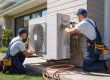


Commercial aircon replacement in Singapore costs between $3,500 and $25,000 per unit, depending on cooling capacity, brand, and installation complexity. A standard 5-HP system for small offices runs $4,000 to $7,000, while larger 10-HP to 20-HP systems for retail spaces or warehouses range from $12,000 to $25,000. These prices include removal of old units, installation, and basic electrical work.

What Affects Commercial Aircon Replacement Pricing?
Your final cost depends on five primary factors. System size matters most because a 500-square-foot office needs far less cooling power than a 3,000-square-foot restaurant. Brand selection also affects pricing, since Daikin and Mitsubishi Heavy Industries charge 15-20% more than mid-tier brands like Midea or Gree, but they offer more extended warranties (5-7 years vs. 3-5 years). Installation complexity adds costs when your building needs new electrical panels, additional piping runs beyond 15 meters, or crane access for rooftop units.
The type of system you choose creates the most significant price spread:
- Cassette units: $4,500-$8,000 for 5-HP systems (ceiling-mounted, four-way airflow)
- Ducted systems: $8,000-$18,000 for 10-HP capacity (hidden in ceiling, covers multiple rooms)
- VRV/VRF systems: $15,000-$45,000+ for multi-split configurations (one outdoor unit serves 3-8 indoor units)
- Package units: $12,000-$25,000 for 15-20 HP (all-in-one rooftop systems for warehouses)
Your existing infrastructure matters. Buildings with outdated electrical systems may need a $1,500- $3,000 panel upgrade before installation can begin.
How Do You Calculate the Right Cooling Capacity?
Commercial spaces need 80-100 BTU per square foot for standard offices, but that jumps to 120-150 BTU per square foot for restaurants and kitchens due to heat-generating equipment. Here’s the breakdown by business type:
| Business Type | Square Footage | Recommended HP | Typical Cost Range |
| Small office | 300-600 sq ft | 3-5 HP | $3,500-$7,000 |
| Retail shop | 600-1,200 sq ft | 5-8 HP | $6,000-$12,000 |
| Restaurant | 800-1,500 sq ft | 8-12 HP | $10,000-$18,000 |
| Warehouse | 2,000-5,000 sq ft | 15-25 HP | $18,000-$35,000 |
Most contractors use the formula: square footage × ceiling height × 25 BTU = total cooling requirement. A 1,000-square-foot office with 9-foot ceilings needs 225,000 BTU, which translates to about 9 HP (24,000 BTU = 1 HP).
Don’t just match your old system’s capacity. If you’ve added more computers, staff, or equipment since the last installation, you’ll need extra cooling power. Undersized systems run constantly and break down faster.
READ MORE: How to Choose the Right Aircon Servicing Package in Singapore (Residential & Commercial)
What’s Included in the Replacement Quote?
Standard commercial replacement includes six components. You get removal and disposal of your old system, which costs $300-$800, depending on refrigerant disposal requirements and accessibility. Installation includes mounting the new indoor and outdoor units, connecting refrigerant lines (up to 15 meters of piping), wiring to your main panel, setting up condensate drainage, and initial system testing with refrigerant pressure checks.
Here’s what costs extra:
- Extended piping beyond 15 meters: $80-$120 per additional meter
- Electrical panel upgrades: $1,500-$3,000 for 100-200 amp capacity
- Crane rental for rooftop access: $500-$1,200 for 4-6 hours
- Asbestos removal (older buildings): $2,000-$5,000
- Weekend or after-hours installation: 30-50% surcharge
- Customized ductwork modifications: $1,200-$4,000
Ask contractors specifically about the maximum pipe length. Some quotes only cover 10 meters, and you’ll pay overrun charges without realizing it. Get the piping measurement in writing before signing anything.
Which Brands Offer the Best Value for Commercial Spaces?
Daikin controls 32% of Singapore’s commercial aircon market, according to the 2024 Building and Construction Authority procurement data. Mitsubishi Heavy Industries and Mitsubishi Electric split another 28% combined. These premium brands cost more upfront but deliver better energy efficiency (CSPF ratings of 4.5-5.2 vs. 3.8-4.2 for budget brands) and longer compressor lifespans.
Here’s the brand comparison:
| Brand | Price Tier | Average 5-HP Cost | Warranty | Energy Rating |
| Daikin | Premium | $6,500-$8,500 | 5-7 years | 5.0-5.2 CSPF |
| Mitsubishi Heavy | Premium | $6,200-$8,200 | 5-6 years | 4.8-5.1 CSPF |
| Midea | Mid-range | $4,500-$6,000 | 3-5 years | 4.0-4.3 CSPF |
| Gree | Mid-range | $4,200-$5,800 | 3-5 years | 3.9-4.2 CSPF |
| York | Mid-range | $5,000-$6,500 | 4-5 years | 4.2-4.5 CSPF |
Mid-range brands work well for businesses planning to relocate within 5-7 years or for those operating in low-usage environments such as storage facilities. Premium brands make sense for restaurants, data centers, or any 24/7 operation where downtime costs you money.
The energy efficiency difference adds up. A 5-HP Daikin unit with 5.0 CSPF costs about $180/month in electricity for 12 hours of daily operation, while a 4.0 CSPF budget unit costs $225/month. That’s $540 in annual savings, which recovers the $2,000 price premium in 3.7 years.
How Long Does Commercial Aircon Replacement Take?
Single-unit installations take 6-8 hours for straightforward replacements. That timeline covers removing the old system, installing the new unit, running refrigerant lines, connecting electrical, testing, and cleanup. You can schedule this during a weekend or after business hours to avoid disruption.
Multi-unit projects stretch across 2-5 days, depending on complexity:
- Day 1: Site assessment, old unit removal, electrical prep work
- Day 2: New outdoor unit installation, refrigerant line routing
- Day 3: Indoor unit mounting, electrical connections
- Day 4: System testing, pressure checks, commissioning
- Day 5 (if needed): Final adjustments, staff training on controls
VRV/VRF systems require 1-2 weeks due to the multiple indoor units and the complex refrigerant balancing required. Contractors typically work in phases, so you’re not entirely without cooling.
The NEA requires that commercial installations have licensed technicians perform refrigerant work. Don’t let contractors rush this part, as improper refrigerant charging accounts for 60% of premature compressor failures, according to the Refrigeration and Air Conditioning Association of Singapore.
What Government Grants Cover Commercial Aircon Replacement?
The Energy Efficiency Grant (EEG) from Enterprise Singapore covers up to 50% of qualifying aircon replacement costs, capped at $30,000 per company. Your new system must have a minimum CSPF rating of 4.3 and be listed on the NEA’s energy-efficient equipment registry. Applications take 4-6 weeks to be approved.
Eligibility requirements:
- Registered business with a minimum 30% local shareholding
- Installing equipment in Singapore
- Replacing the existing system (not a new installation)
- Using NEA-registered contractors
- System meets Minimum Energy Performance Standards (MEPS)
The Energy Efficiency Fund (E2F) offers loans up to $250,000 at 5% interest for energy-saving retrofits. You’ll need to show projected energy savings of at least 15% compared to your current system. Most premium brands easily hit this target.
SME Energy Efficiency Scheme participants get an additional 10% subsidy on top of EEG, bringing total support to 60% of costs. Check whether your industry qualifies, as the F&B, retail, and hotel sectors often have specific programs.
Should You Replace or Repair Your Current System?
Replace your commercial aircon when repair costs exceed 50% of its replacement value, or when the system is over 12 years old. Compressor failure alone costs $2,500-$4,500 to fix on a 5-HP unit, and if your system is 10+ years old, you’re spending money on outdated technology that uses 40-50% more electricity than current models.
Signs you need replacement, not repair:
- Compressor failure on systems over 8 years old
- Repeated refrigerant leaks requiring gas top-ups every 6-12 months
- Monthly electricity bills increased 30%+ compared to two years ago
- Uneven cooling that persists after duct cleaning and filter changes
- R22 refrigerant systems (R22 was phased out in 2020, making repairs increasingly expensive)
Calculate your break-even point. If you’re spending $1,200/year on repairs and paying $400/month extra for electricity due to poor efficiency, that’s $6,000 annually. A new $8,000 system pays for itself in 16 months through energy savings alone.
Repair makes sense for systems under 5 years old with minor issues like fan motor failures ($400-$800), control board replacements ($300-$600), or drainage problems ($150-$400). Get a second opinion if a contractor pushes to replace a relatively new system after a single component failure.
How Do You Choose a Reliable Aircon Contractor?
Check three things before hiring anyone. First, verify that they hold a valid BCA license for air-conditioning work and that their technicians hold NEA refrigerant-handling licenses. Second, ask for at least three recent commercial project references in buildings similar to yours. Third, compare itemized quotes from 3-4 contractors because pricing varies by 20-30% for identical work.
Red flags that indicate you should walk away:
- Quotes significantly lower than competitors (30%+ below market rate)
- Pressure to sign contracts immediately with “limited time offers”
- Refusal to provide written warranties or project timelines
- Can’t produce BCA license or NEA refrigerant handling certificates
- No insurance coverage for property damage during installation
- Vague quotes without brand specifications or model numbers
Good contractors offer 1-year workmanship warranties in addition to manufacturer warranties. They’ll also provide free annual maintenance visits for the first year to catch any installation-related issues early.
Ask about their response time for post-installation problems. The best companies guarantee 24-48-hour service calls if something goes wrong during the first 90 days. This matters because issues like refrigerant leaks or electrical problems usually show up within the first month of operation.
What’s the Real Payback Period on Energy-Efficient Models?
High-efficiency air conditioning systems recoup their premium cost in 3-5 years through lower electricity bills. A 5-HP office unit running 12 hours daily, 26 days monthly costs approximately $2,700 annually in electricity with a 4.0 CSPF rating. Upgrade to a 5.0 CSPF unit and you’ll pay $2,160 yearly, saving $540.
The math for a typical upgrade scenario:
- Standard efficiency unit (4.0 CSPF): $5,500 purchase + $2,700/year electricity
- High efficiency unit (5.0 CSPF): $7,500 purchase + $2,160/year electricity
- Price difference: $2,000
- Annual savings: $540
- Payback period: 3.7 years
Over a 12-year lifespan, the efficient unit saves $6,480 in electricity costs, giving you a net benefit of $4,480 after accounting for the higher upfront cost.
F&B businesses see faster payback (2-3 years) because they run systems longer hours with higher cooling loads. Retail shops with 8-hour operating days might take 4-5 years to break even, but they’ll still come out ahead over the equipment’s life.
Factor in maintenance costs too. Efficient systems with inverter compressors typically need fewer repairs because they don’t cycle on and off constantly. Budget $300-$500 annually for maintenance on premium units vs. $500-$800 for standard efficiency models that work harder.
Key Takeaways for Commercial Aircon Replacement Costs
- Commercial aircon replacement costs $3,500-$25,000 per unit in Singapore, with 5-HP office systems averaging $4,000-$7,000 installed.
- System capacity should be 80-100 BTU per square foot for offices, 120-150 BTU for restaurants and kitchens with heat-generating equipment.
- Premium brands (Daikin, Mitsubishi) cost 15-20% more but deliver 4.8-5.2 CSPF efficiency ratings vs. 3.9-4.3 for mid-range brands.
- The Energy Efficiency Grant covers up to 50% of costs (capped at $30,000) for systems that meet a minimum 4.3 CSPF requirement.
- Replace systems that are 12 years old or older, or when repair costs exceed 50% of the replacement value.
- High-efficiency units recoup their premium pricing in 3-5 years through annual electricity savings of $500-$800.
- Standard installation takes 6-8 hours for single units, 2-5 days for multi-unit commercial projects.
- Verify that contractors hold BCA licenses and NEA refrigerant-handling certificates before signing any contract.