

An aircon replacement involves removing your old air conditioning unit and installing a new system that matches your home’s cooling needs, budget, and energy efficiency goals. The right replacement improves comfort, reduces energy bills by 20-40%, and prevents frequent breakdowns that cost hundreds in emergency repairs.
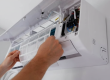
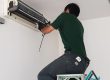
 Professional aircon installation in residential home
What Size Air Conditioner Do You Need for Your Home?
The first step in choosing an air conditioner replacement is getting the size right. You’ll need to calculate your home’s cooling capacity in British Thermal Units (BTUs) or kilowatts.
Here’s how room size translates to cooling power:
- 10-15 square meters: 9,000 BTU (2.5 kW)
- 15-25 square meters: 12,000 BTU (3.5 kW)
- 25-35 square meters: 18,000 BTU (5.0 kW)
- 35-50 square meters: 24,000 BTU (7.0 kW)
But square footage alone won’t give you the full picture. Ceiling height matters. If your ceilings are higher than 2.7 meters, you’ll need to increase capacity by 10-15%. Also consider how many windows you have (each large window adds heat), which direction they face (west-facing windows get afternoon sun), and how many people typically occupy the space.
An oversized unit cycles on and off too frequently, which wastes energy and fails to remove humidity properly. An undersized unit runs constantly, driving up electricity costs and never quite reaching your target temperature. Professional installers use Manual J calculations to determine precise sizing, which factors in insulation quality, local climate, and heat-generating appliances.
Which Type of Air Conditioning System Works Best for Home Replacement?
You’ve got several options when replacing your air conditioning system. Each type has distinct advantages depending on your home layout and budget.
Split system air conditioners remain the most popular choice for single-room cooling. They cost $600-$2,500 installed and work efficiently for bedrooms, home offices, or living rooms. The outdoor compressor connects to an indoor unit through a small hole in the wall.
Multi-split systems let you cool multiple rooms with one outdoor unit connected to 2-5 indoor units. Installation runs $3,000-$8,000 but saves exterior space if you’re cooling 3-4 rooms. Each indoor unit operates independently, so you’re not cooling empty bedrooms.
Ducted systems provide whole-home cooling through ceiling vents. They cost $7,000-$15,000 installed, but deliver seamless temperature control across your entire house. You’ll need ceiling space for ductwork, which makes them ideal for new builds or major renovations.
Portable units ($300-$800) don’t require installation, but they’re temporary solutions. They’re noisy, less efficient, and take up floor space. Only consider these if you’re renting or need emergency cooling.
Window units ($200-$600) cool single rooms effectively, but block natural light and can’t be secured properly in modern windows. They’ve largely been replaced by split systems in most markets.
What Energy Efficiency Rating Should You Look For?
Energy efficiency directly impacts your monthly electricity bills. In Singapore, look for units with at least 4 ticks on the National Environment Agency (NEA) energy label. In Australia, check for high Energy Rating labels. US buyers should verify SEER (Seasonal Energy Efficiency Ratio) ratings of 16 or higher.
Inverter technology makes the biggest difference in efficiency. Traditional non-inverter units run at full power until the room reaches temperature, then shut off completely. They cycle on and off repeatedly, which wastes energy. Inverter aircons adjust compressor speed continuously, maintaining steady temperatures while using 30-60% less electricity.
A 2.5 kW inverter aircon running 8 hours daily costs roughly $25-35 per month in electricity. The same capacity non-inverter unit costs $45-60 monthly. Over a 10-year lifespan, the inverter saves you $2,400-$3,000, which more than covers its higher upfront cost.
R32 refrigerant has become the industry standard, replacing older R410A and R22 gases. R32 reduces global warming potential by 68% compared to R410A and improves energy efficiency by 5-10%. When comparing units, verify they use R32 refrigerant.
How Do You Choose a Reliable Aircon Installation Company?
Your aircon replacement is only as good as the installer who puts it in. Poor installation causes 60% of premature system failures, according to industry studies.
Start by verifying licensing and insurance. In Singapore, contractors need PUB and BCA licenses. Australian installers must hold ARC (Refrigerant Handling) licenses. US technicians need EPA Section 608 certification. Ask to see these credentials before signing any contracts.
Check online reviews, but don’t just look at star ratings. Read the actual comments. Look for mentions of punctuality, cleanup quality, and how the company handles problems. Three or four detailed positive reviews tell you more than 50 generic five-star ratings.
Get at least three written quotes. Each should itemize equipment costs, labor, materials, and disposal fees for your old unit. The cheapest quote usually means corners will be cut. The most expensive doesn’t guarantee better work. Look for the company that explains its process clearly and answers your technical questions without getting defensive.
Ask these specific questions:
- What warranty covers the equipment and installation work?
- Do you conduct a site inspection before quoting?
- How do you handle refrigerant leaks after installation?
- What’s included in your post-installation service?
- Can you provide references from jobs completed in the past 6 months?
Professional installers inspect your electrical panel to confirm it can handle the new unit’s load. They check wall integrity before drilling. They use quality copper piping, not aluminum. They vacuum the refrigerant lines properly before charging the system. And they test everything thoroughly before leaving your property.
What Features and Add-Ons Are Worth Paying For?
Modern aircons come loaded with features. Some improve comfort and save money. Others are marketing gimmicks that add cost without real value.
Wi-Fi connectivity ($50-150 extra) lets you control your aircon remotely through smartphone apps. You can turn on cooling before leaving work or adjust the temperature from bed. If you travel frequently or have irregular schedules, this feature pays for itself by preventing energy waste.
Air purification filters remove dust, pollen, and bacteria. HEPA filters ($30-80 to replace annually) capture 99.97% of particles. If anyone in your home has allergies or asthma, this matters. Otherwise, standard filters cleaned monthly work fine.
Auto-restart function turns your aircon back on at the previous settings after power outages. Without this, your unit stays off during hot nights if the electricity flickers. It’s usually a standard feature on mid-range and premium models.
Sleep mode gradually adjusts temperature overnight, maintaining comfort while reducing power consumption by 20-30%. Worth having if you run your aircon all night.
Swing and directional airflow prevent cold air from blasting directly at people. Basic feature that should be standard.
Self-cleaning function runs the evaporator at high temperatures to prevent mold and bacteria growth. Reduces maintenance frequency and improves air quality. Good to have, but not critical.
Skip the ionizers, “nanoe” technology, and other proprietary air treatment systems unless you have specific health needs. They add $200-500 to the price with minimal practical benefit for most households.
How Much Should You Budget for Aircon Replacement?
Total replacement costs include equipment, installation, and disposal of your old unit.
Basic split system replacement:
- Equipment: $600-$1,200
- Installation: $300-$600
- Old unit disposal: $50-$100
- Total: $950-$1,900
Mid-range inverter system:
- Equipment: $1,200-$2,000
- Installation: $400-$700
- Disposal: $50-$100
- Total: $1,650-$2,800
Premium smart inverter:
- Equipment: $2,000-$3,500
- Installation: $500-$800
- Disposal: $50-$100
- Total: $2,550-$4,400
Multi-split systems multiply these costs by the number of indoor units, minus some savings on shared outdoor equipment.
Installation costs vary based on difficulty. Ground-floor units with short pipe runs cost less. Fourth-floor installations with 15-meter pipe runs cost 40-60% more. If your electrical panel needs upgrading ($300-$800), that’s an additional expense.
Many companies offer 0% interest payment plans over 6-12 months. This makes sense if you can pay it off before interest kicks in. Otherwise, you’re better off saving up or using a low-interest personal loan.
When Is the Best Time to Replace Your Aircon?
Don’t wait until your old unit dies during a heatwave. That’s when you’ll make rushed decisions and pay premium rates for emergency installation.
Replace your aircon if:
- It’s over 10 years old, and repair costs exceed 50% of the replacement cost
- You’re spending $300+ annually on repairs
- Your electricity bills have increased by 30% without usage changes
- The unit struggles to cool on hot days
- You hear grinding, squealing, or rattling noises
- You notice water leaking or ice forming on coils
- Refrigerant needs frequent top-ups
Schedule replacements during off-peak seasons (late autumn or early spring in most climates). Installation companies offer 10-20% discounts when they’re not slammed with emergency calls. You’ll also get better installation slots and more time for the crew to do quality work.
What Maintenance Keeps Your New Aircon Running Efficiently?
Your replacement unit won’t deliver promised efficiency without regular maintenance.
Do these monthly:
- Clean or replace air filters
- Wipe down the indoor unit exterior
- Check that the outdoor unit has clear airflow (no leaves, debris, or plants within 50cm)
Schedule professional servicing every 3-6 months. Technicians should:
- Check refrigerant levels
- Clean evaporator and condenser coils
- Inspect electrical connections
- Test thermostat accuracy
- Lubricate fan motors
- Clear condensate drains
Standard servicing costs $60-$120 per visit. Skip it, and you’ll reduce efficiency by 15-20% within the first year. Coils accumulate dirt that acts as insulation, forcing the compressor to work harder.
Most manufacturers void warranty coverage if you can’t prove regular professional maintenance. Keep service records organized.
Key Takeaways for Choosing Aircon Replacement
- Calculate cooling capacity based on room size, ceiling height, windows, and insulation before shopping
- Inverter technology with R32 refrigerant delivers 30-60% energy savings compared to non-inverter units
- Verify installer licensing, insurance, and recent customer references before signing contracts
- Budget includes equipment ($600-$3,500), installation ($300-$800), and old unit disposal ($50-$100)
- Replace units over 10 years old or costing $300+ annually in repairs
- Wi-Fi control and air purification filters provide practical value, while ionizers and “nanoe” technology are usually unnecessary
- Schedule replacement during off-peak seasons for 10-20% discounts and better installation quality
- Professional maintenance every 3-6 months prevents 15-20% efficiency loss and protects warranty coverage