



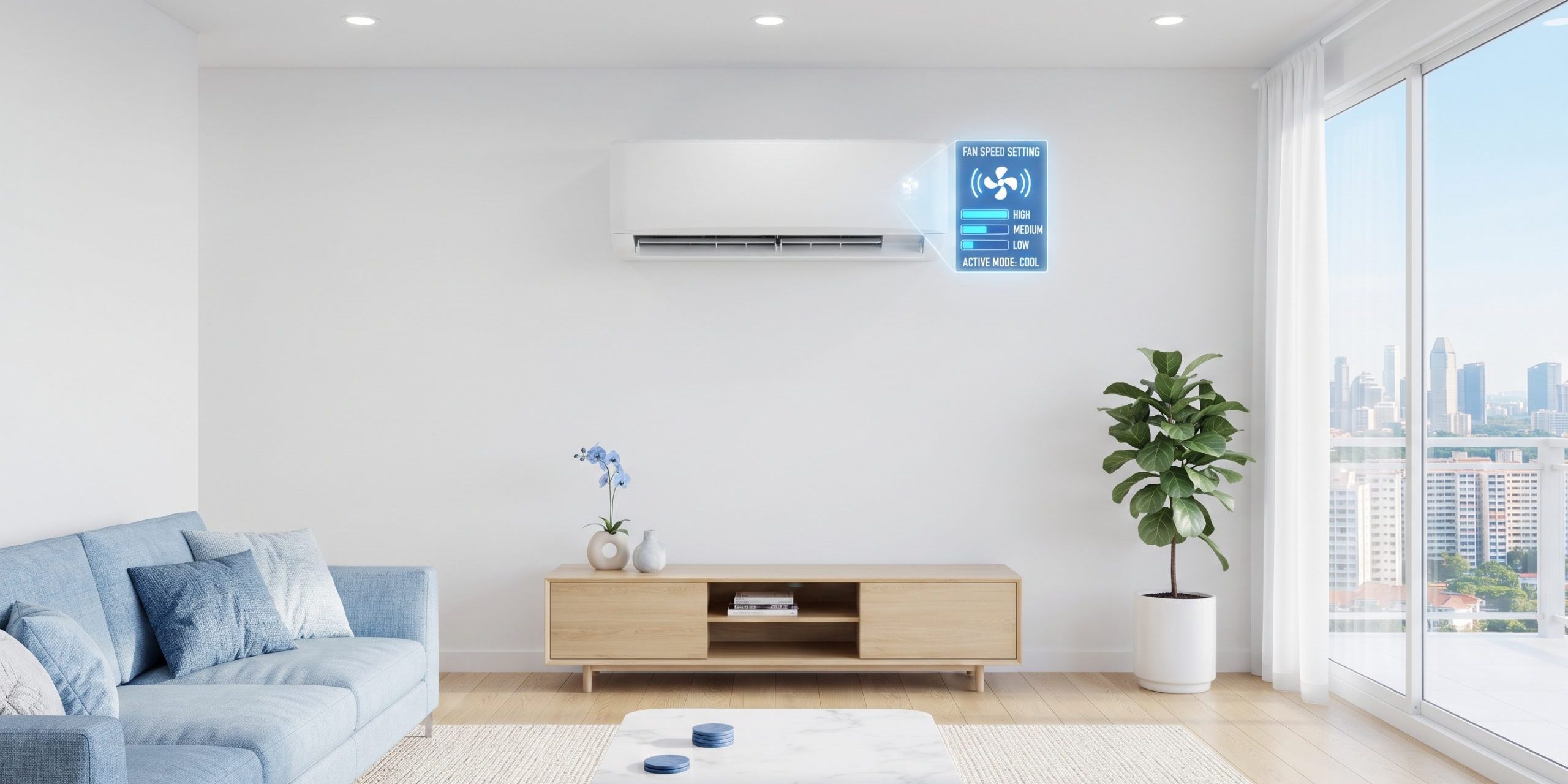
Understanding how to properly utilize your aircon’s fan speed settings is one of the most effective ways to maximize comfort while minimizing monthly electricity bills in Singapore’s humid tropical climate. Many homeowners default to keeping the fan speed locked on a single mode—either keeping it on High permanently or relying strictly on Auto—without realizing how airflow velocity directly impacts dehumidification, coil heat exchange, and power consumption.
Fan Speed Category Breakdown
The fan speed setting on your remote controller directly adjusts the internal cylindrical blower wheel (squirrel-cage fan) inside the indoor unit. Selecting the right speed balances air volume (measured in CFM) against room humidity and cooling speed:
- High Fan Speed (High CFM): Moves the maximum volume of air across the evaporator coil. It rapidly circulates hot air out of a room and creates a immediate “wind-chill” effect on human skin, making 24°C feel like 22°C without overworking the compressor.
- Low Fan Speed (Low CFM): Reduces airflow velocity, forcing warm, humid air to remain in contact with the freezing cold evaporator coil for longer. This maximizes moisture condensation (dehumidification), producing crisp, dry air ideal for night sleeping.
- Auto Fan Speed (Dynamic Control): The indoor printed circuit board (PCB) automatically calculates the difference between the actual room temperature and your thermostat setpoint. It runs the blower on high during the initial cool-down phase and ramps down to low once the desired setpoint is reached.
How to Set and Optimize Your Aircon Fan Speed
1.Initial Rapid Cooldown Phase:Set fan to High with a 24°C–25°C setpoint upon entering.
When turning on your aircon in a warm room, set the fan speed to High for the first 20 to 30 minutes. This rapidly breaks up heat pockets and circulates cool air across the entire room.
2.Steady-State Humidity Control Phase:Switch to Low or Auto speed once comfortable.
Once the room feels comfortable, lower the fan speed to Low or Auto. Lowering the air velocity allows the unit to extract ambient atmospheric humidity effectively.
3.Overnight Sleep Optimization:Lock fan speed to Low or Quiet Mode overnight.
Set the fan speed to Low before sleeping. This reduces operating noise to whisper-quiet levels, preserves sleep quality, and prevents the room from becoming overly dry or chilled.
Master Reference Table
| Fan Speed Setting | Airflow Output (9,000 BTU Unit) | Moisture Removal Rate | Noise Level | Primary Recommended Usage | Energy Bill Impact |
| High Fan | High (~450 – 550 CFM) | Lower (Air moves across coil too fast) | Noticeable (~38–45 dB) | Initial room cooldown (first 20–30 mins) | 🟢 Very Low (Blower motor power draw is negligible) |
| Medium Fan | Moderate (~350 – 450 CFM) | Moderate | Moderate (~30–35 dB) | Steady daytime cooling in occupied living spaces | 🟢 Very Low |
| Low / Quiet Fan | Low (~250 – 350 CFM) | Maximum (Longer coil contact time) | Whisper Quiet (~19–25 dB) | Nighttime sleep & sticky/rainy day humidity control | 🟢 Lowest |
| Auto Fan Mode | Variable (~250 – 550 CFM) | Dynamic (Adjusts automatically) | Variable | Hands-free general daily usage | 🟢 Lowest (Prevents unnecessary high-speed overuse) |
| Turbo / Powerful | Maximum (~550 – 700 CFM) | Minimum | Loudest (~45+ dB) | Extreme heat waves (10–15 mins max) | 🟡 Slightly Higher |
DIY vs. Professional Maintenance Matrix
🟢 Safe to DIY
- Regular Mesh Filter Washing: Cleaning the plastic indoor dust filters every 2 to 4 weeks to prevent airflow starvation and dust build-up.
- Manual Fan Mode Selection: Switching between High, Low, and Auto settings depending on room occupants and time of day.
- Adjusting Air Louvers: Setting directional swing vanes upward when running high fan speeds to optimize natural cold air distribution.
🔴 Requires Professional Repair & Servicing
- Blower Wheel Chemical Overhaul: Stripping down and chemical jet washing a choked cylindrical blower wheel when airflow feels weak despite selecting “High” fan speed.
- Fan Motor & Bearing Replacement: Diagnosing screeching sounds, seized bearings, or burned-out motor windings causing fan failure.
- Control Board PCB Repairs: Fixing malfunctioning PCB relays or thermistors that prevent the system from cycling fan speeds automatically.
⚠️ CRITICAL SAFETY WARNING: If your air conditioner’s fan speed is set to “High” but air velocity coming from the louver feels noticeably weak, uneven, or emits a sour, musty odor, your internal blower wheel is choked with dust and mold build-up. Operating a choked blower wheel starves the system of air, causes the evaporator coil to freeze into ice, and risks burning out the fan motor.





