When your Carrier air conditioner encounters an operational anomaly, safety trip, or hardware glitch, its internal microcomputer generates a diagnostic error code on the digital display panel or through blinking indicator lights. This comprehensive guide helps you understand what these codes mean, how to safely reset your system, when you can perform DIY checks, and what professional repairs typically cost in Singapore.
Error Code Category Breakdown
Carrier systems categorize faults by letter prefixes to isolate the affected internal module:
- E Series (System & Communication Faults): EEPROM configuration memory errors, indoor-outdoor communication drops, indoor fan motor control failures, and room thermistor trips.
- EC Code (Refrigerant Leakage): Advanced system detection logic identifying abnormal pressure drops or insufficient gas levels.
- F Series (Outdoor & Sensor Faults): Outdoor ambient, condenser coil, and compressor discharge temperature sensor open or short circuits.
- P Series (Inverter & Electrical Protection): IPM inverter drive overcurrent trips, voltage supply fluctuations, and compressor thermal protection triggers.
How to Read and Reset Carrier Error Codes
Reading the Code
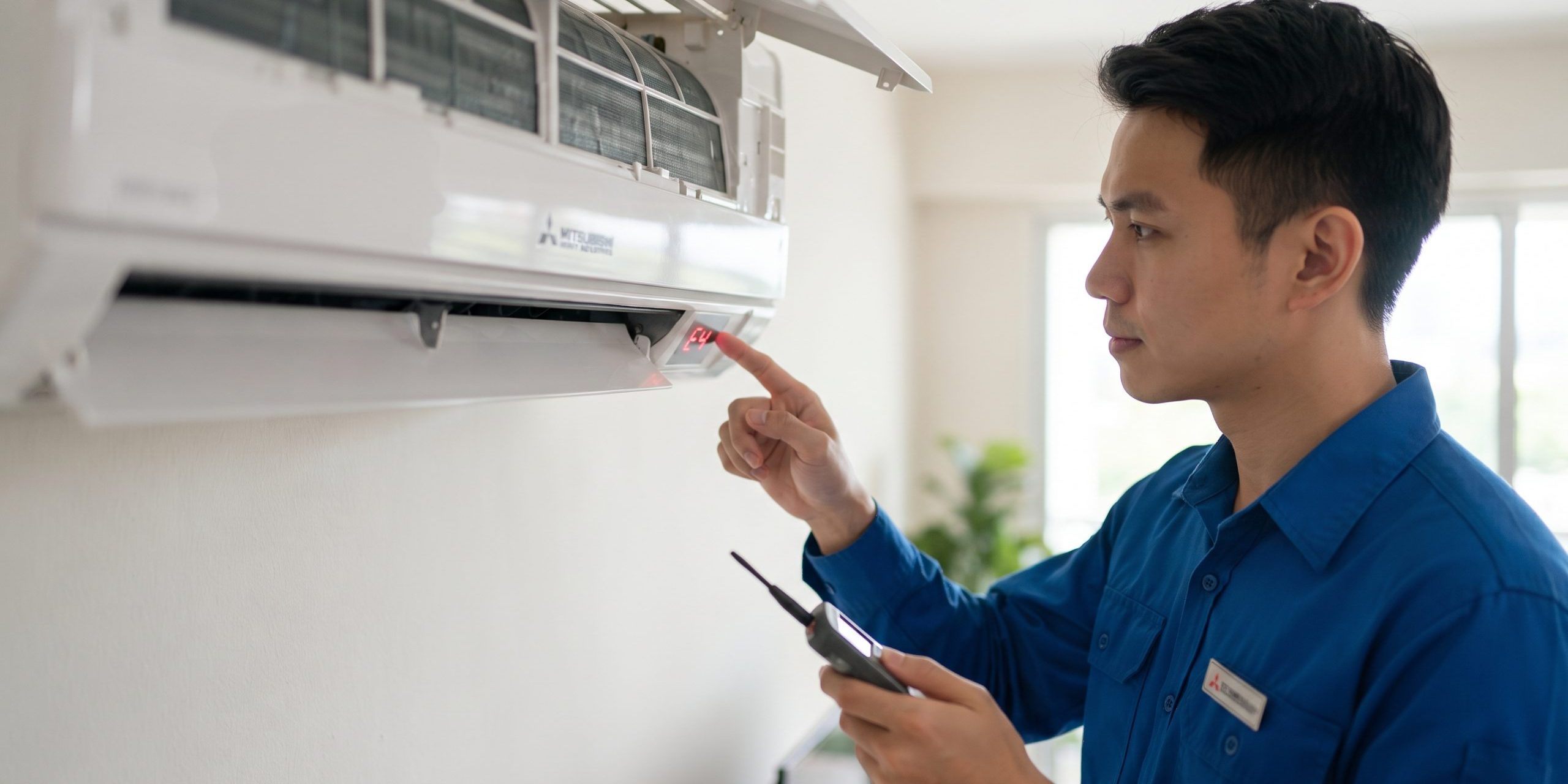
- Digital LED Panel: Most modern Carrier wall-mounted split units display a two-character code directly on the front panel screen.
- Blinking LED Indicator Lights: On units without digital screens (or certain cassette models), count the repetitive flash intervals of the Operation or Timer lights.
Performing a System Hard Reset
To determine whether an error is caused by a temporary power spike or a physical hardware fault:
- Power Down: Turn off the aircon via the remote controller, then turn off the main wall isolator switch.
- Capacitor Discharge: Wait at least 5 minutes to allow internal circuit board capacitors to fully clear.
- Power Restoration: Switch the main wall power back on and start the system.
- Evaluate Result: If the error code does not return, it was a transient grid or communication glitch. If it reappears immediately, an active hardware fault requires attention.
Master Error Code Reference Table
| Code | Meaning / Likely Cause | Severity | Recommended Action | Typical SG Cost |
| E0 | Indoor EEPROM parameter memory error | Medium | Board configuration check or indoor PCB replacement. | $130 – $450 |
| E1 | Indoor-outdoor communication error | High | Check outdoor isolator power; inspect terminal wiring & PCBs. | $80 (Diag) / $300–$600 |
| E2 | Zero-crossing signal or frequency detection fault | High | Power supply grid check; technician diagnosis required. | $250 – $450 |
| E3 | Indoor fan speed out of control | High | Clear fan blockages; inspect blower motor and capacitor. | $200 – $350 |
| E4 | Indoor room temperature sensor (T1) fault | Medium | Replace defective indoor room thermistor. | From $130 |
| E5 | Evaporator coil sensor (T2) fault | Medium | Replace indoor evaporator pipe sensor. | From $130 |
| EC | Refrigerant leakage detected | High | Perform nitrogen pressure test, seal leak, and recharge gas. | From $180 |
| F1 | Outdoor ambient temperature sensor (T4) error | Medium | Replace outdoor ambient air thermistor. | From $130 |
| F2 | Condenser coil temperature sensor (T3) error | Medium | Replace outdoor condenser thermistor. | From $130 |
| F3 | Compressor discharge temperature sensor (T5) error | High | Replace discharge thermistor to prevent overheating. | From $130 |
| F4 | Outdoor unit EEPROM parameter error | High | Outdoor control board parameter reprogramming or PCB replacement. | $130 – $600 |
| F5 | Outdoor fan speed out of control | High | Inspect outdoor fan motor, blade obstructions, or fan driver. | $200 – $350 |
| P0 | IPM (Inverter Power Module) malfunction | High | Check outdoor heat sink, ventilation, and inverter board. | $300 – $600 |
| P1 | Over or under voltage protection | High | Check household voltage stability with an electrician. | $200 – $400 |
| P2 | Compressor top temperature protection | Critical | Clean blocked condenser coils or check for low refrigerant gas. | $180 – $750 |
| P4 | Inverter compressor drive error | Critical | Inverter drive circuit failure; technician diagnosis required. | $300 – $600 |
DIY vs. Professional Repair Matrix
🟢 Safe to DIY / Homeowner Managed
- Power Reset: Performing a wall isolator hard reset to clear transient grid spikes or communication drops.
- Filter Cleaning: Washing and drying indoor mesh air filters regularly to prevent airflow restrictions and freezing.
- Outdoor Clearance: Removing dust, leaves, and wall obstructions around the outdoor compressor unit to maintain airflow.
- Isolator Check: Confirming the outdoor power isolator switch has not accidentally been switched off (resolving simple E1 errors).
🔴 Requires Professional Technician
- Refrigerant Leak Tracing (EC, P2): Executing nitrogen pressure testing, flare joint tightening, brazing, and precise gas top-ups.
- Electrical & Inverter Diagnostics (P0, P1, P4): Testing outdoor inverter boards, power modules, and incoming supply voltages.
- Sensor Replacements (E4, E5, F1–F3): Extracting and replacing broken or shorted indoor/outdoor thermistors.
- Motor & Compressor Swaps (E3, F5, P2): Replacing faulty indoor blower motors, outdoor fan motors, or damaged compressors.
⚠️ CRITICAL WARNING FOR HIGH-SEVERITY FAULTS
Codes like EC, P0, P2, and P4 point to active compressor overheating, inverter module trips, or severe refrigerant loss. Do not force the aircon to keep running under these codes. Continued operation risks burning out the compressor motor or destroying the main circuit board, escalating repair costs from a minor component fix to a full system replacement. Switch off the unit immediately.