



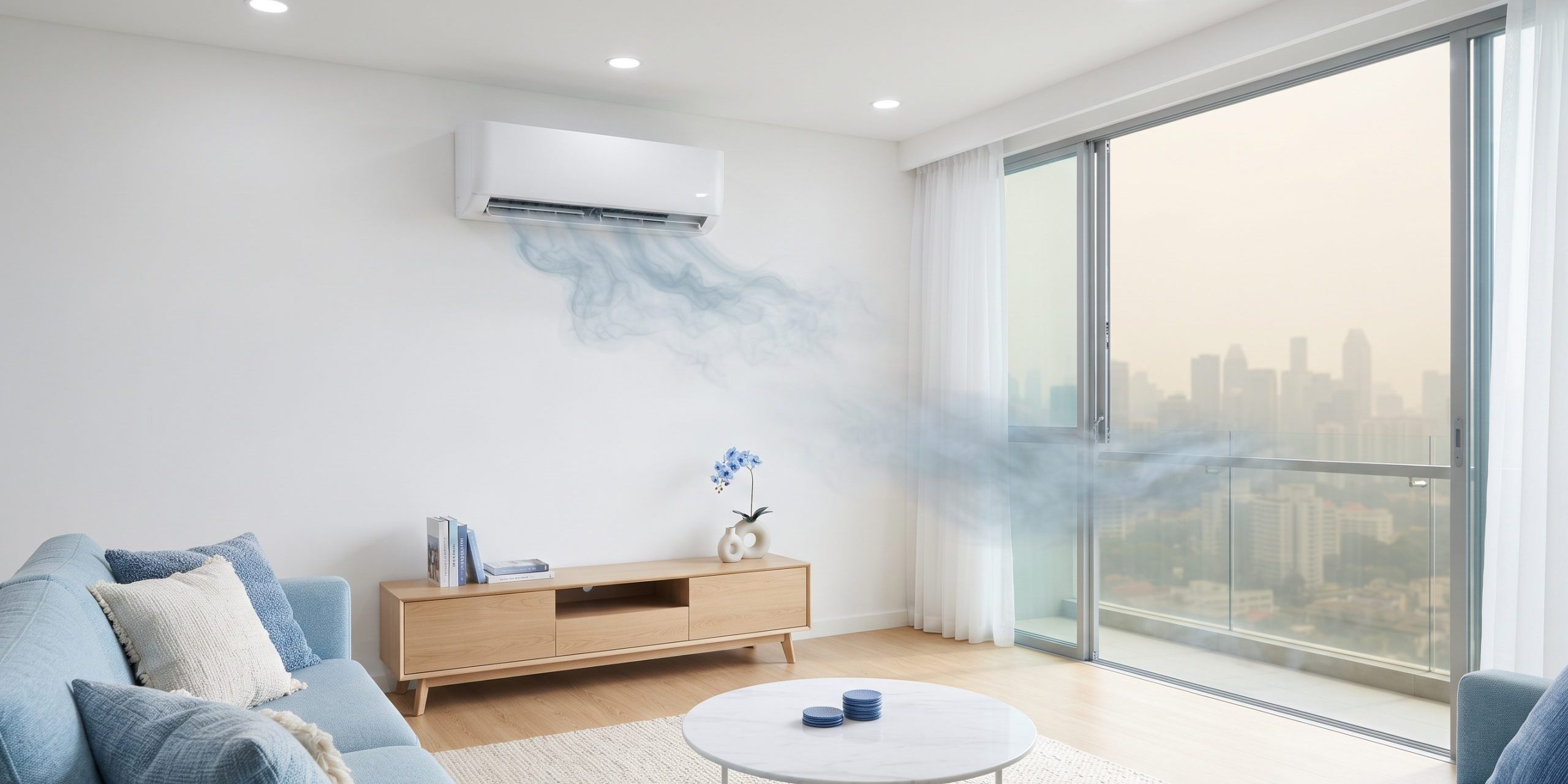
During seasonal transboundary haze episodes or regional forest fires affecting Southeast Asia, air quality in Singapore can drop significantly. Many homeowners wonder: Can your home air conditioner bring in smoke from the outside? The short answer is no, standard residential split air conditioners do not pull outdoor air into your home. However, understanding how different aircon systems handle smoke, fine particulate matter (PM2.5), and odors is essential for maintaining a clean indoor environment during hazy conditions.
1. Overview & Aircon Smoke Categories
To understand how smoke interacts with your cooling systems, it helps to look at how different aircon designs process indoor and outdoor air:
- Standard Split Aircon Units (Closed-Loop System): Residential split units recirculate indoor air exclusively. They draw air from your room, pass it over cold refrigerant coils to cool it, and blow it back into the same room. They do not have an outdoor air intake duct.
- Fresh Air / Mechanical Ventilation Systems: Common in some commercial offices, condominiums, or specialized smart homes, these systems actively draw in outdoor air to ventilate indoor spaces and can introduce smoke if not filtered correctly.
- The Odor Misconception: Even though split units don’t pull in outside air, smoke odors can still seep into your home through window gaps, doors, or exhaust vents, and subsequently get trapped in damp, dusty aircon filters.
2. Smoke Protection & Aircon Setup Guide
1.Seal Windows and Doors:
Keep all windows and exterior doors tightly shut during severe haze or smoke advisories to prevent outdoor particulate matter from drifting indoors.
2.Rinse and Clean Mesh Filters:
Wash your indoor aircon mesh filters every 1 to 2 weeks during haze seasons to remove trapped dust and prevent odors from recirculating.
3.Deploy HEPA Air Purifiers:
Pair your aircon operation with a standalone HEPA air purifier to actively scrub PM2.5 smoke particles from the indoor air.
4.Avoid Fresh-Air Damper Settings:
If your system has a fresh-air ventilation intake option, close the damper temporarily so the unit operates strictly on indoor recirculation.
3. Reference Table: Smoke, Haze & Aircon Performance
| Aircon / Haze Factor | How It Affects Your Home | Recommended Action | Typical SG Solution |
| Split Unit Recirculation | Recirculates indoor air; does not pull in fresh outdoor smoke directly. | Clean filters regularly; keep windows sealed. | Standard filter wash ($15–$30) |
| Smoke Smell / Odor | Trapped smoke particles settle on dusty evaporator coils and emit burning odors. | Schedule a thorough chemical wash to strip trapped residue. | Chemical wash ($90–$180) |
| PM2.5 Particulate Build-up | Fine soot particles pass through standard mesh filters and coat internal coils. | Use high-grade air purifiers alongside your aircon. | Air purifier integration |
| Fresh Air Intake Units | Actively pulls outdoor air inside (common in some condos/commercial spaces). | Install high-efficiency MERV/HEPA inline filters on intake ducts. | Professional HVAC duct check |
4. DIY vs. Professional Smoke Maintenance Matrix
⚠️ Warning: Never spray generic aerosol deodorizers, strong perfumes, or DIY chemical cleaners directly into your aircon fancoil unit to mask smoke odors. This can damage electronic circuit boards or react hazardously with trapped soot.
🟢 Safe to DIY / Self-Check
- Filter Washing: Regularly removing, washing with mild soap, and air-drying indoor mesh filters to reduce trapped particulate loading.
- Sealing Gaps: Applying weather-stripping tape around doors and window frames to block smoke infiltration from outside.
- Air Purifier Deployment: Running portable HEPA air purifiers inside air-conditioned bedrooms to clear airborne smoke.
🔴 Requires Professional Aircon Servicing
- Chemical Coil Overhauls: Deep pressure-flushing of evaporator coils to eliminate stubborn smoke residue, oily soot, and burnt odors trapped deep inside.
- Blower Wheel Cleaning: Removing and washing the internal blower drum where fine dust and smoke particles accumulate over time.
- Drainage & Pan Flushing: Clearing blocked condensate drain lines that can trap stagnant, smoke-polluted moisture.





